
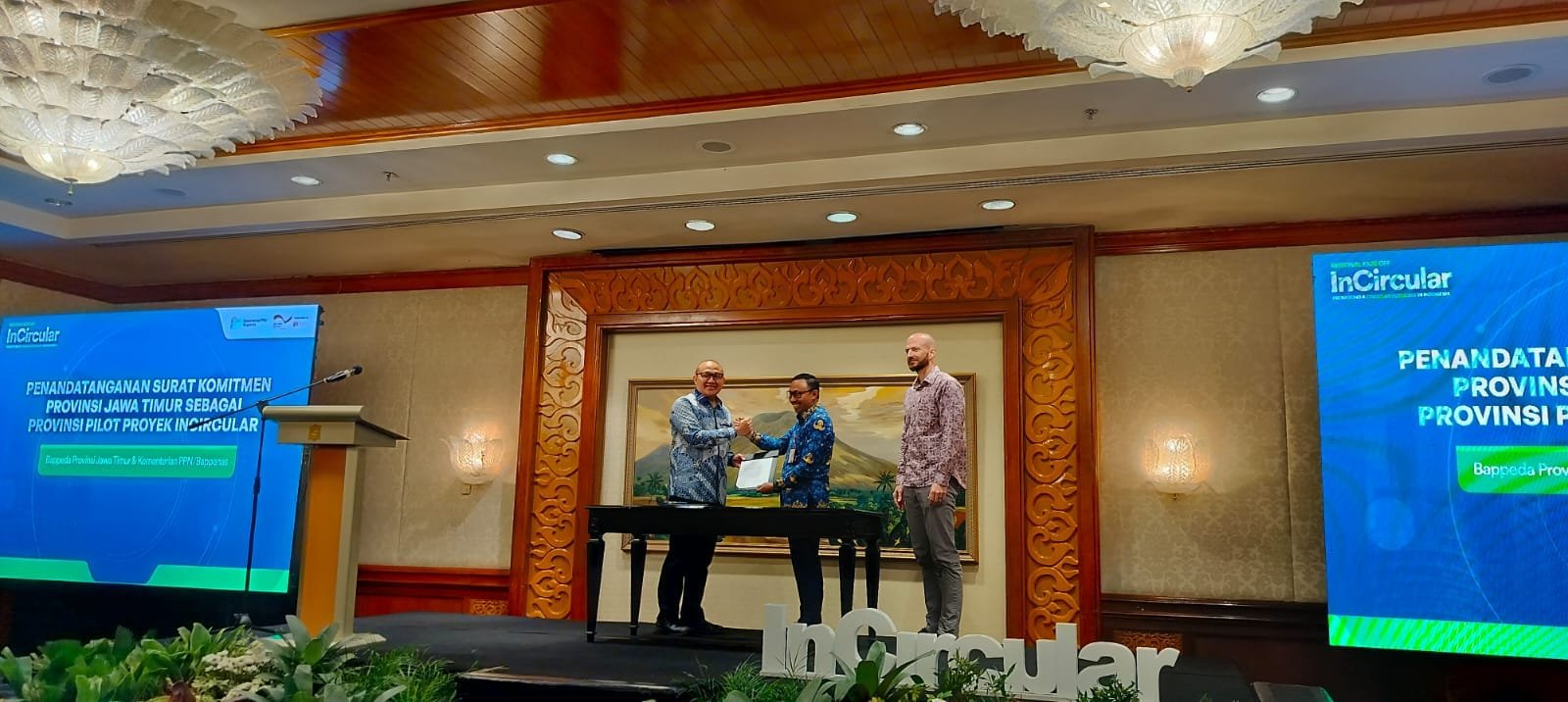
Surabaya, April 17, 2026 – The InCircular Project, a result of Indonesia–Germany cooperation, was officially launched in Surabaya on Friday (April 17, 2026). This initiative aims to strengthen the ecosystem for plastic waste utilization as part of the transition toward a circular economy in East Java Province.
The launch was opened by the Acting Head of the East Java Regional Development Planning Agency (Bappeda), M. Yasin, who emphasized the importance of shifting the current waste management paradigm. According to him, the linear approach—take, use, dispose—has led to an increasing demand for landfill space.
“If we continue using a linear system, the need for landfill areas will keep expanding. Even regional landfills have become a burden for the provincial government. Therefore, we strongly encourage a circular economy approach to reduce the need for landfills,” he stated.
In line with this, the Ministry of National Development Planning (PPN/Bappenas) continues to promote the implementation of a circular economy through a national roadmap. The five priority sectors identified are food, construction, plastics, electronics, and textiles.
The Director of Environment at Bappenas, Nizhar Marizi, highlighted the significant potential of the circular economy in Indonesia. “The implementation of a circular economy is projected to increase the national Gross Domestic Product (GDP) by IDR 593 to 638 trillion by 2030. Additionally, it has the potential to reduce waste generation by 18–25 percent,” he explained.
However, he also pointed out a major challenge in the plastic sector: the limited supply of high-quality recycled raw materials, despite the large volume of plastic waste generated in Indonesia. This issue has become increasingly critical amid global trends where industries are shifting toward more environmentally friendly products.
In the development of the InCircular Project, Bintari has supported GIZ through various preliminary studies. This support includes stakeholder analysis, mapping of the recycling industry, and material flow analysis to better understand the flow and potential utilization of plastic waste in East Java.
With this launch, it is expected that cross-sector collaboration among government institutions, industry players, and development partners will accelerate the realization of a more sustainable and economically valuable plastic waste management system.